Liquid Dryer Systems
Removing Moisture From Solvents And Other Chemicals
Why dry liquid chemicals? For the same reason that it is necessary to dry compressed air and other gas streams; moisture can be a contaminant to many chemicals in both gas and liquid phases. Moisture contamination can affect the efficiency of some catalyst-driven reactions, the quality of chemical products, and the operating costs of solvent recovery systems. Moisture-induced corrosion can shorten useful life of equipment, resulting in catastrophic failures of vessels, piping, or valves carrying hazardous chemicals.
Hazards increase further when operating at elevated pressures and/or temperatures. Corrosion has been the cause of many deaths and injuries in boilers and other pressure vessel accidents. A 2010 report by The National Board of Boiler and Pressure Vessel Inspectors (NBBI) indicated that for the reporting period of 1992 to 2001 there were a total of 23,338 pressure vessel related accidents which averages at 2,334 accidents per year. The reporting year 2000 saw the highest number of accidents at 2,686 with the lowest at 2,011 in 1998. Whether pressure vessels contain air, hazardous gases or liquids, a rupture can result in injury to personnel and damage to equipment. Drying gas and liquid chemicals is a good way to protect against corrosion, reduce operating costs, and improve safety.
Choosing a method to dry a chemical in the liquid phase depends on the chemical composition, the number of steps required in the drying process including pretreatment methods, whether the drying is to be a continuous or batch process, the SDS hazards including chemical reactions during drying, the containment requirements, the quantity to be dried per hour, the moisture range in the feed and the acceptable limit in the dried stream. Methods for drying liquid chemicals include distillation, spray drying, freeze drying, vacuum drying, solvent extraction, and desiccant drying.
Desiccant dryers using regeneratable desiccants are well-known as an efficient way to dry gas streams of air, natural gas, and many other flammable gases. Liquids can be dried in the same way by passing the liquid though a bed of desiccant. The desiccant absorbs the moisture until the bed is saturated to its operating limit. At that point a single tower dryer must be taken offline to regenerate the bed. Dual tower dryers can continue to dry by alternating towers so that the desiccant bed in one tower is drying while the other bed is being regenerated.
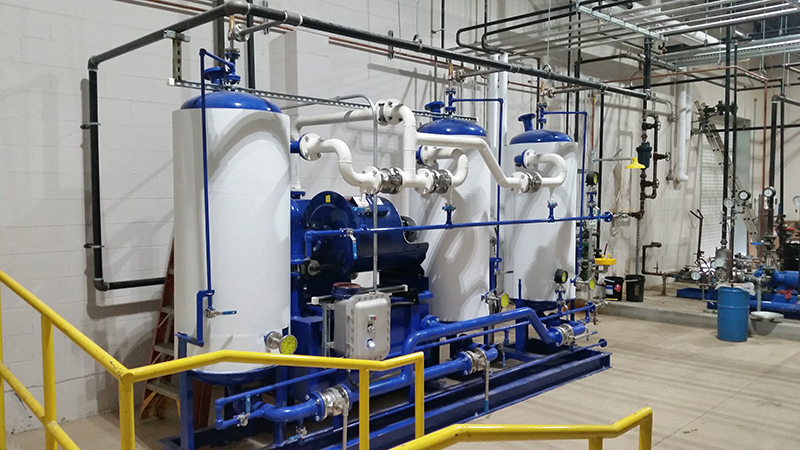
Most liquid dryers have microprocessor controllers that can connect to central computer systems. They’re simple to operate and can handle flow rates of 100 GPM and more. The operating, maintenance, and capital costs to achieve low levels of moisture in the dried chemical stream tend to be lower than other systems.
Desiccant bed regeneration can be done by heat and/or pressure drop, depending on the desiccant. Ion exchange resins, molecular sieves, silica gel, and activated alumina are often used for drying liquids. Ion exchange resins have high sorption capacity and are regenerated at lower temperatures. Molecular sieve, activated alumina, and silica gel require high temp regeneration. Activated alumina can be used with very low temperature feed streams.
The material used to construct liquid dryer towers and piping is usually stainless steel or another corrosion resistant metal. The complexity of liquid phase dryers is significantly higher than for gas phase dryers. Many liquid dryers require explosion-resistant design. Measuring the moisture in a liquid is more difficult than measuring it in a gas stream. Two accurate lab-based moisture measuring methods for liquids include loss on drying and using chemical reagents to do volumetric and coulometric comparisons. Field instruments for measuring moisture in liquids include RF and other dielectric measurements. These must be calibrated frequently against a certified standard.
A liquid desiccant dryer cannot make as large of a percentage reduction from a high concentration of moisture in one step that a gas dryer can. A typical desiccant compressed air dryer rated for 100 PSIG and a -40°F pressure dew point can make a 500 to 1 reduction in one step. Large reductions using desiccant liquid dryers can require several steps. At elevated moisture levels it is impractical to make very large percentage reductions in a single step due to the size of the desiccant bed required. For example, to reduce the moisture level in a liquid feed stream from 2,500 ppm down to 1 ppm, the first step could be a 5 to 1 reduction, followed by a 10 to 1 reduction, and finally a 50 to 1 reduction. Pretreatment methods using anhydrous calcium sulfate or calcium chloride with gravity, centrifugal, or filter separation can reduce high moisture levels in the feed stream to the dryer. Pretreating the feed stream allows for a higher percentage reduction to be done in one step by the dryer, or for the use of a smaller dryer.
Drying Liquid Chlorinated Hydrocarbon Solvents
Liquid Chlorinated Hydrocarbons solvents like Methylene Chloride, Trichloroethylene, and Trichloroethane can be dried using a desiccant dryer.
Liquid Methylene Chloride Desiccant Dryer
This Solvent Drying System built by Process Systems, LLC uses ion exchange resin for the water removal. It is a liquid phase drying system designed to remove water from various solvents. It uses a closed-loop reactivation with dry nitrogen recirculated through the resin beds to remove the water by heating the resin. The nitrogen is recirculated using a blower, steam reactivating heater, cooler condenser and separator. The system is operated by Allen-Bradley PLC and is fully automatic. Level switches determine when the towers are full and empty. Prior to reactivation, the solvent from the online tower is transferred to the off-line tower (reactivated). Nitrogen is used to force the solvent from the online tower over to the reactivated tower.
System Operation (The Basics)
Desiccant systems for liquid dehydration have two basic cycles — adsorption (where water is removed by passage of the liquid through the desiccant material) and reactivation (where the water is stripped from the desiccant by the application of heat). The operations are described below.
Adsorption
The removal of dissolved water from liquids is accomplished by passage of the liquid through a freshly reactivated packed column of granular desiccant material.
Continuous operation is accomplished by use of dual adsorbers, with one tower on the process stream while the other is being reactivated.
Reactivation is accomplished in the following steps:
- Drain the tower of liquid product.
- Heat the desiccant to release water.
- Remove released water from the tower.
- Cool and refill.
 Before reactivating a tower, the single volume of process liquid must be emptied. Low-volatility liquids can be drained or pumped into a storage tank. Many highly volatile liquids (e.g., propane) can be pumped or pressurized (by heating) back into the process line.
Heating of the desiccant in the type ~IH” model dryer is accomplished with internal heaters (electric or steam) in conjunction with the use of a dry nonreactive purge gas in the convection dryer by passing a hot gas stream through the bed. During reactivation the residual process liquid and adsorbed water are vaporized as reactivation temperatures are attained.
The reactivation gas flow provides the means for removing product and water vapors. Some highly volatile liquids can be vaporized to provide the source for the reactivation gas. A vaporizer for this purpose can be provided as an accessory.
Before placing a reactivated tower in service, the bed should be cooled (i.e., by radiation or by continued circulation of cool regeneration gas). Many liquids are sufficiently stable so that cooling of the desiccant can be accomplished by quenching or self-refrigeration at the time of filling.
Process Systems liquid dryers are offered in two basic designs, internal heat reactivation (IH type) and external heat reactivation (Convection type).
Reactivation system alternatives include:
I. Type of Reactivation System
A. Open (once through)
B. Closed (recirculated high or low pressure)
C. Open Heating, Closed Cooling
II. Heat Source
A. Electric
B. Steam
C. Electric and Steam Combination
Ill. Reactivation System Components
A. Heater only
B. Heater and Blower
C. Heater and Cooler
D. Heater, Cooler, and Blower or Pump
IV. Reactivation Flow Configuration
A. Cocurrent or Countercurrent Heating, No Cooling
B. Cocurrent Heating and Cooling
C. Countercurrent Heating and Cooling
D. Countercurrent Heating, Cocurrent Cooling
Process Systems applies 30 years of experience in adsorption systems to the design of liquid dryers. Process Systems is capable of designing liquid dryers for many diverse applications. A partial list of typical liquids dried by Process Systems includes:
Aromatics—Benzene, Toluene, Xylene
Saturated Hydrocarbons—Propane, Butane, Pentane, Hexane
Unsaturated Hydrocarbons—Butadiene, Butene, Propylene- Propane Mixtures, Acetylene
Chlorinated Hydrocarbons—Methylene Chloride, Trichloroethylene, Trichloroethane
Miscellaneous Liquids—Ethanol, Vinyl Chloride, Acetone, Tetrahydrofuran, Dimethylacetamide, Methyl-Ethyl-Ketone, Ethylene Dichloride, Normal Paraffins, Kerosene
Process Systems, LLC
Process Systems specializes in custom filtration and adsorption applications with over 20 years of experience in the field. This includes dealing with the removal of condensates, particulate matter and water from liquid, gas and air streams under both low pressure and high-pressure systems involving automated process controls, valves and instrumentation. Field services are available on any equipment dealing with these applications.
Consultant services are available to analyze a specific application and provide recommendations for improvements and, if needed, design specific equipment for a specific problem to meet the process needs and/or to provide energy reduction.
Mission Statement:
Process Systems is dedicated to Quality Engineering and Customer Service. Dedicated to making every effort to consistently apply the highest standards and provide the best quality in our products, designs and customer support. Be responsive to our clients’ needs in the most efficient way possible. Provide straightforward recommendations using sound engineering principles and practices. Use the highest quality parts and equipment to meet the requirements and specifications of our clients. Warrant our equipment and make every effort to ensure our clients’ complete satisfaction and dedicated to on-time excellence.
Process Systems builds specially designed desiccant dryers for both liquids and gases. Many of these systems have been built for hazardous feed materials such as those listed above. The dryers are often built to stringent electrical codes. An example is the electrical specification for a Heptane dryer as follows:
The electrical design was NEMA7 explosion proof (Class I, Group C/D, Division 1). Junction boxes were cast NEMA7 explosion proof boxes. All instruments and penetrations to the boxes utilized explosion-proof seal fittings with flexible explosion-proof connections at the instrument for service.
Other Process Systems dual tower dryer models available include externally heated air open circuit and closed circuit, pressure swing, and heated purge. Single tower and multiple tower models are available for drying liquids in lab scale and full scale for testing new products. Process Systems has also built dryers for drying radioactive gas applications.
Andress Engineering Associates, Inc. (AEA) has been a dealer for process desiccant dryers since 1956. This includes specialty compressed air and gas dryers by several manufacturers.
For information on specialty liquid and gas phase desiccant dryers visit our equipment page.
Email: carl@andressengineering.com
Web Manager Email: taylor@andressengineering.com
Phone: (800) 437-4211 or (800) 228-7922
Sources:
Photos and Case Study: Process Systems
Data: NBBI and other public sources