Fall Arrest Systems
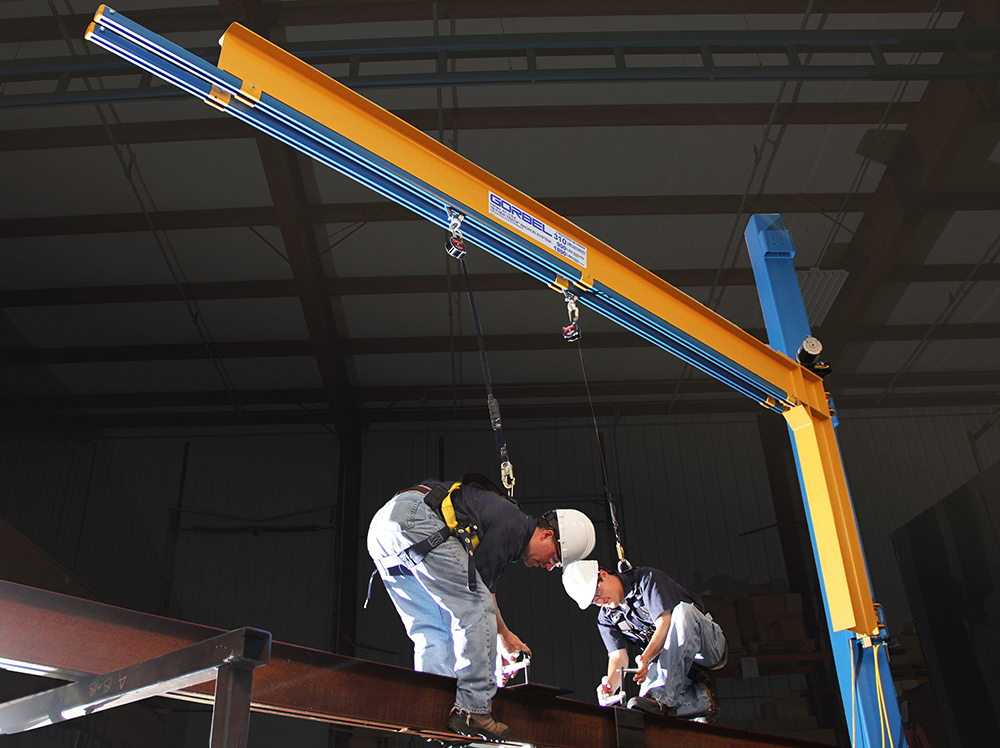
Worker Fall Arrest Protection When Loading/Unloading Trucks & Railcars
The lack of a fall arrest protection system when working on top of trucks, trailers, railcars, or locomotives can have fatal consequences. If approved and certified fall arrest equipment is not available on a jobsite, if parts of the fall arrest system are not in serviceable condition, or if a worker resists using it, they run the risk of serious injury or death, and create a legal liability for the employer.
A worker may resist using fall arrest equipment due to discomfort, improper fit, or claim it can slow down the task at hand. All these reasons can contribute to accidents resulting in injury or death – much less comfortable.
According to the National Safety Council (NSC), for 2021, the industry sector experiencing the largest number of preventable fatal injuries was construction, followed by transportation and warehousing. The NSC estimates the cost of a fatal work injury at approximately $1,131,000 and puts the costs of a non-fatal medically consulted injury at around $44,000. The US Bureau of Labor Statistics (USBLS) for 2019 cite falls, slips, and trips as the most frequent type of fatal event in the construction industry, representing 37.9 percent of all fatalities (418 of 1,102). Most fatal falls, slips, and trips are from falls to a lower level. Non-fatal emergency room visits are also dominated by fall-related injuries, accounting for 33% of all preventable nonfatal injuries.
Who Regulates And Why?
Multiple government agencies regulate fall arrest protective systems. Construction and warehousing rules are regulated by OSHA. Mining industries are regulated by MSHA, and common carrier railroads are regulated by the FRA. Usually, railcar switching operations on privately owned track are regulated by OSHA or MSHA.
MSHA issued 92 imminent danger orders for people working at heights without fall protection between January 2019 and June 2020. The most common violations were truck drivers climbing atop their vehicles, and maintenance and quarry personnel working without fall protection in high places.
When loading materials from flatbed trailers, flatcars, tanker trailers, or tank cars, it is often necessary for a worker to have to work on top of a vehicle – climbing on top of a railcar to guide or strap down a load, open, close hatches, inspect… All of which can put the worker in jeopardy of falling, especially when working outside in rain, high wind, or icy conditions.
Each regulator requires many categories of personal protective equipment to meet standards developed by ANSI. An ANSI approved fall arrest protection device anchored to a CMAA manufacturer’s overhead support system can provide the worker a much safer working condition.
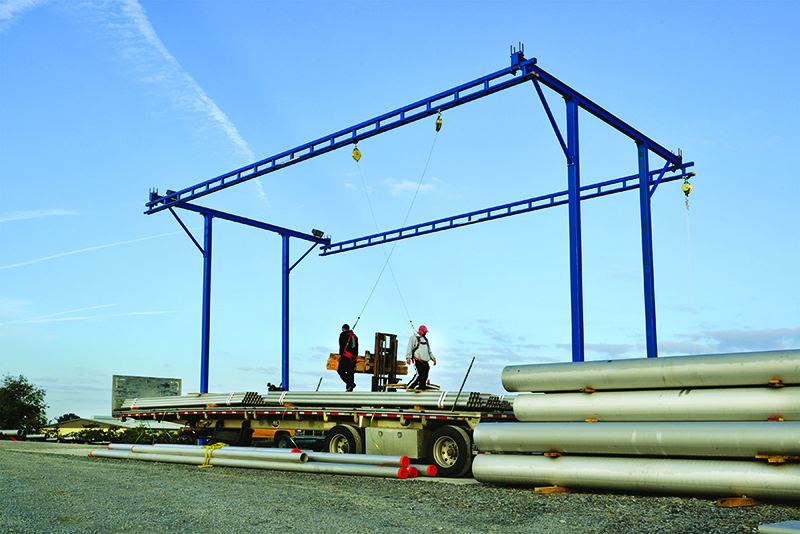
Loading Flatbed Truck With Pipe: The monorail shown uses dual track, allowing two workers to pass one another without disconnecting the lanyard from their harness.
Choosing Safety
Mike Vance, Director of Engineering at Bristol Metals in Tennessee bears a burden in that his job is all about keeping people safe. “We’re a manufacturer of stainless steel pipe, and all day we’re loading flatbed trucks with multiple stacks of the pipe for shipment,” said Vance.
Having stepped up their safety program in recent years, Vance and his safety team took a proactive look at health and safety risks at the facility, and identified truck loading as the highest safety risk for their employees.
While on the bed of the trucks, all workers fall under OSHA’s requirement to have some form of fall protection. OSHA 1926 requires fall protection for employees who work at elevation, defined as 4’ per OSHA 1910 for general industry and 6’ per OSHA construction standards. The company explored several solutions to maintain an effective loading process while creating a safer work environment.
“We looked into a new building that would have overhead cranes to load the trucks,” said Vance, “but that didn’t change anything for the workers, who would still need to be tied off. We talked about using man‐lifts to reach over and keep the men off the truck, but after studying the situation, it would be very difficult to effectively load unless they can actually be on the truck.”
They found a solution, with a lower cost than a new building that allowed the workers to remain on the truck, in the form of two free standing Tether Track fall protection systems by Gorbel®. The primary system features two cantilevered monorails, enabling two flatbeds to be loaded in the same area simultaneously. Each monorail uses Gorbel’s dual track, allowing two workers to pass one another safely without disconnecting the lanyard from their harness.
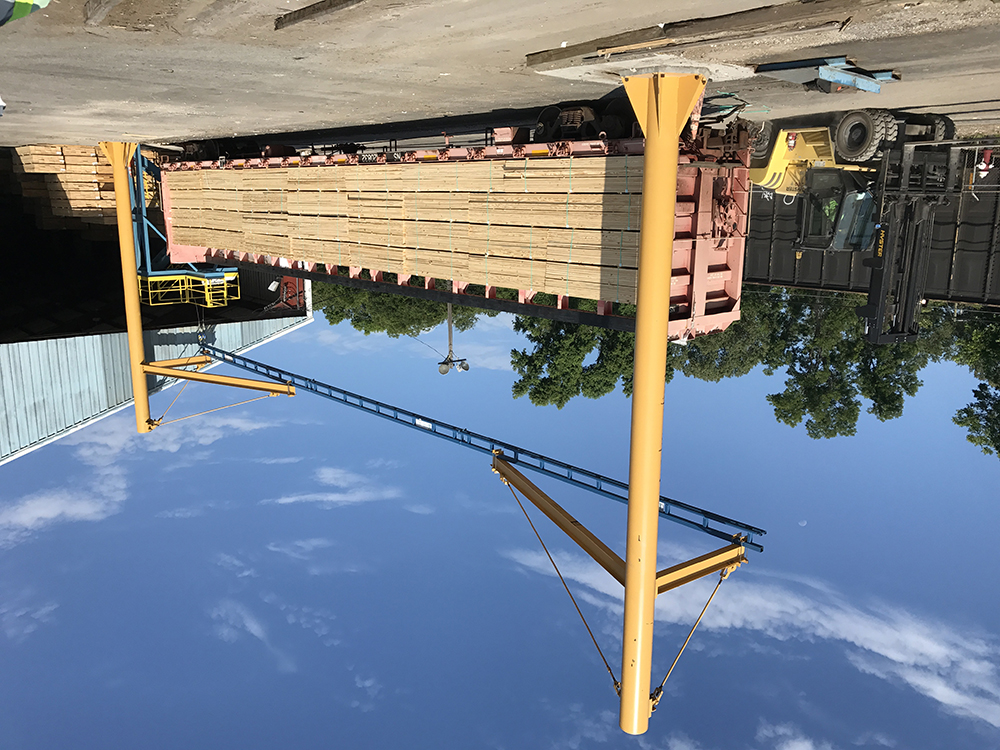
A second Tether Track system featured a single cantilevered monorail, also with the dual track. “We narrowed it down to two companies, and we chose Gorbel Tether Track™ based on the fact that they had the dual track and we could put two men up there and they could pass each other,” said Vance. “The other systems that we found could not offer that.”
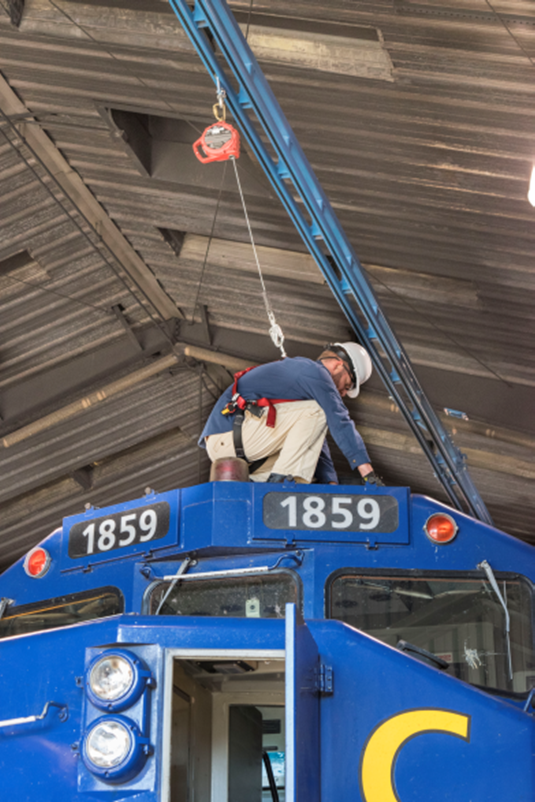
Working on Top of Railcars and Locomotives
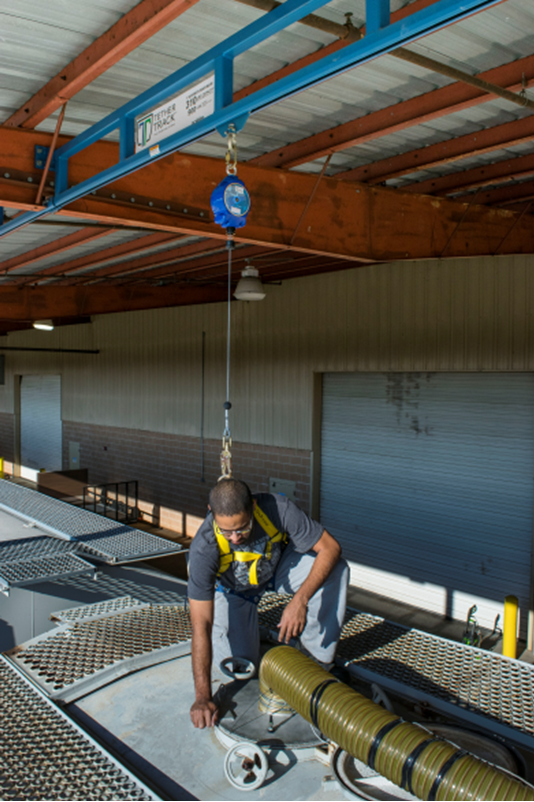
Whether transporting by common carrier trucking or by railroad, the jobs of loading and unloading materials and equipment require very similar skills and PPE. When standing on equipment with wheels there’s also a chance of movement due to being bumped, brakes failing, or an insecure chock. If the trailer or railcar moves suddenly workers may lose their balance and fall. When doing maintenance work on a railcar or locomotive the track that it is sitting on must be completely locked out, handbrake applied, and wheels chocked.
Example: Employees at a recycled plastics facility needed to go on top of the railcars to fill the railcars and take samples of plastic pellets extruded from post-consumer and post-industrial plastics. A fall protection system was needed to keep the employees safe. Suspending the track from the canopy that covered the loading area would encroach on railroad requirements, specifically the distance from the track to the bottom of the fall protection system. The Gorbel distributor was able to come up with an innovative design that followed railroad requirements.
A Gorbel Tether Track™ monorail system was chosen as the best option, and by notching the canopy beams, the track was able to be raised up into the girder underneath. The notched areas were then reinforced with angle iron that was bolted into place. This allowed for the proper height requirements to be met. The Tether Track Fall Protection System gave the on-site safety manager reassurance that the employees were kept safe when on top of the rail cars.
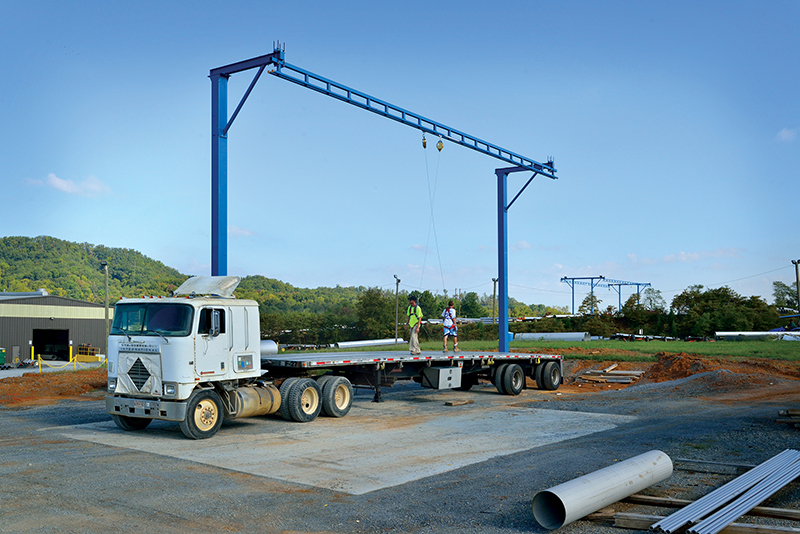
Working Together: When a job requires two people working together, the dual Gorbel Tether Track system allows two workers to pass each other while they are both supported by the same overhead track system. The dual Gorbel Tether Track System can be mounted from overhead beams, jib cranes, or free standing gantry cranes.
The Cost Of Doing Nothing Can Be Very High
Improper fall protection equipment and training for employees and contractors can result in injury or death to the worker, along with consequential damage to other persons and equipment. In addition there is the prospect of civil fines by OSHA, MSHA, or FRA. These are a few examples of the possible civil fines:
OSHA:
OSHA violations for fall protection were the #1 source of violations for fiscal year 2017. Many of these violations were specifically related to training requirements and ensuring that a training program for each employee who may be exposed to fall hazards was established. OSHA violations can result in significant civil penalties. The OSHA website describes the minimum and maximum dollar amount for various fines resulting from OSHA violations: The maximum for civil penalties for assessments is $15,625, while Willful or Repeated violations can reach
$156,259 per violation.
MSHA:
MSHA violations can result in even more significant dollar amount civil penalties than those from OSHA. According to the American Society of Safety Professionals: The maximum for MSHA civil penalties for regular assessments is $72,620, while the maximum for flagrant violations increases to $266,275. The mandatory minimum fine for failing to report a fatality or serious injury within 15 minutes was hiked to $6,052, while penalties for failing to abate a violation can now reach $7,867 per day.
Andress Engineering Associates, Inc. (AEA) has been a dealer for overhead material handling systems, Trackmobile® mobile railcar movers, and desiccant type liquid and gas drying equipment since 1956. This includes overhead bridge cranes, monorail systems, jib cranes, hoists, and other under hood devices including but not limited to fall protection equipment, vacuum lifters, manipulators, and more.
For information on Gorbel Fall Arrest Systems visit: www.andressengineering.com
Crane Department Email: adavidson@andressengineering.com
Web Manager Email: taylor@andressengineering.com
Phone: (800) 228-7922
Sources:
- Gorbel Tether Track™ case studies were supplied by Gorbel®
- Data from: OSHA, MSHA, FRA, NSC, ANSI, CMAA websites